


The short answer
How much should I charge for a TikTok post? Start from your average views, not your follower count. Take your typical views per video, price them per 1,000 views, check the result against the rates for your tier, and add extra for any use of the video beyond your own account.
In Kolect’s 2026 data, typical paid fees for one video run from about $150 for small accounts to about $1,000 for accounts over 1 million followers. Published rate guides list higher numbers, especially for big accounts. Both kinds of numbers are below, each with its source.
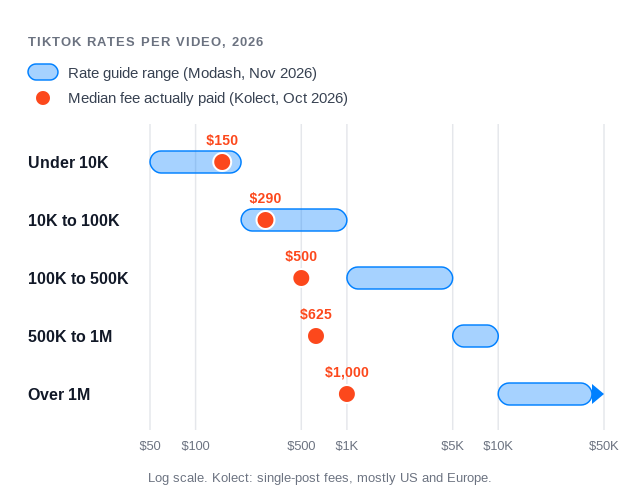
TikTok influencer rates by follower tier in 2026
Three sources published TikTok rates in October and November 2026. They measure different things, so read them side by side.
| Followers | Influencer Marketing Hub guide (Oct 2026) | Modash guide (Nov 2026) | Kolect median paid fee (Oct 2026) |
|---|---|---|---|
| Under 10K | $50 to $200 | $50 to $200 | $150 |
| 10K to 100K | $200 to $800 | $200 to $1,000 | $290 |
| 100K to 500K | $800 to $5,000 | $1,000 to $5,000 | $500 |
| 500K to 1M | $800 to $5,000 | $5,000 to $10,000 | $625 |
| Over 1M | $5,000 to $50,000+ | Over $10,000 | $1,000 |
Rate guides give these tiers names. From smallest to biggest, they are nano, micro, mid-tier, macro and mega.
- Influencer Marketing Hub calls its numbers planning benchmarks, not fixed rate cards. It uses one band for 100K to 1M followers.
- Modash gives ballpark prices for creators in North America.
- Kolect reports fees that brands and creators actually agreed in its client programs, from August 2025 to October 2026. Most of those deals were in consumer tech, home, DIY and lifestyle, with creators mostly in the US and Europe. Kolect says most of the fees already included Spark Ads or other paid use of the video.
One more data point from a marketplace of mostly small deals. The Collabstr 2026 report found that TikTok packages on its site asked $182 on average in 2025, and brands paid $186 on average. Across every platform on Collabstr, about 80% of deals cost under $300.
For small accounts, the sources mostly agree. Bigger creators should know that the top of a rate guide is a ceiling, not a typical fee.
Why your views matter more than your followers
Brands buy attention, and on TikTok that means views. Two facts from the 2026 data explain why followers alone are a weak guide.
- Big accounts reach a smaller share of their followers. In Kolect’s data, the typical account under 10,000 followers got views equal to about 32% of its followers per video. The typical account over 1 million got about 5%.
- Engagement per view barely changes with size. Kolect found it steady at about 7% to 9% across tiers. So once a brand prices on views, a big account is not a worse deal on likes and comments.
Modash puts it more bluntly. One of its experts calls follower count “a largely meaningless metric on TikTok.” Its advice to brands is to look at the views on a creator’s last dozen or so videos, drop the very high and very low ones, and average the rest. It adds that sponsored posts usually get fewer views than normal ones, so brands plan on the low side.
That is good news for small creators with strong views. A 20,000-follower account whose videos reach 15,000 people has a better case than a 100,000-follower account stuck at 3,000.
How to work out your TikTok rate in 4 steps
This is how to work out how much to charge for a TikTok post of your own.
- Find your average views. Open your last 12 videos. Drop the one with the most views and the one with the least. Average the other ten.
- Price the views. Divide your average by 1,000, then multiply by a rate per 1,000 views. Ad people call this rate CPM. Use two anchors. One Modash expert sets $20 per 1,000 views as the most a brand should pay. Kolect’s median paid rate was $55.74 per 1,000 views for accounts with 10K to 100K followers, and far higher for smaller ones.
- Check your tier and your engagement. Compare the result with the table above. Then run your last ten videos through our free TikTok engagement rate calculator. If it beats the 7% to 9% that Kolect found typical, ask for the top of your range.
- Add the extras. Modash lists the usual ones. Usage rights add anywhere from a quarter of your base fee to the full fee again, depending on where and how long the brand uses the video. Running your post as a Spark Ad from your account, also called whitelisting, adds about 25% to 30% for 30 days. Exclusivity, which means avoiding rival brands for a while, should cost more, too.
Kolect’s per-view medians by tier, for reference: $225.45 per 1,000 views under 10K followers, $55.74 for 10K to 100K, $14.99 for 100K to 500K, $13.31 for 500K to 1M and $6.85 above 1M. Small accounts get more per view, but fewer views in total.
A worked example
Here is the math for a made-up creator. Change the numbers to yours.
- Followers: 20,000.
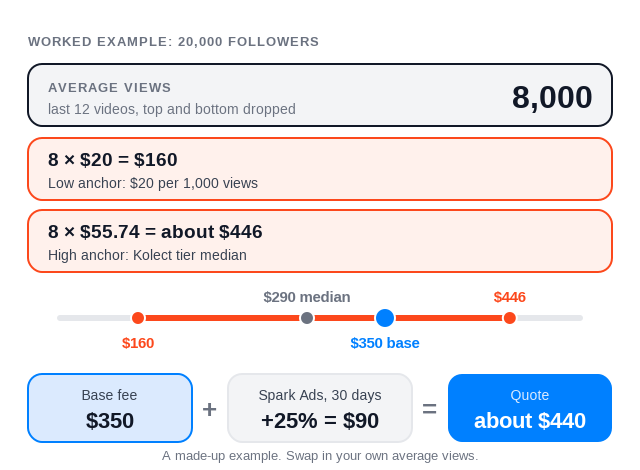
- Average views: 8,000 (last 12 videos, highest and lowest dropped).
- Engagement rate by views: 10%, above the 7% to 9% that Kolect found typical.
Step 2, the anchors. At $20 per 1,000 views, 8,000 views is worth 8 × $20 = $160. At Kolect’s tier median of $55.74, it is 8 × $55.74 = about $446.
Step 3, the tier check. The 10K to 100K tier runs $200 to $800 in one guide and $200 to $1,000 in another, with a median paid fee of $290. The example sits inside all of them.
Step 4, the quote. Strong engagement points to the upper half of the range. A fair opening price for one video here is about $350. If the brand wants to run it as a Spark Ad for 30 days, add 25%, or about $90. The full quote comes to about $440.
What else moves your price
- Your niche. In Collabstr’s 2026 report, the most expensive niches across all platforms were skilled trades at $309 per deal, education at $307, and business at $295. Beauty, at $210, was the most affordable. Collabstr says expert topics draw viewers who are already looking to buy.
- Where your viewers live. Modash says brands pay less per 1,000 views for audiences in Latin America than for the US or Western Europe. TikTok Studio shows your top countries.
- How much work the brand asks for. More videos, more drafts and tight deadlines all cost more. Price each one.
- How the video will be used. Your own feed only, or ads, the brand’s website and other apps too? Ask before you quote.
If you are still deciding whether brand deals are the right goal, we compare every way to earn on TikTok, with the follower rules. TikTok’s own pay per view is covered in how much does TikTok pay.
Asking price vs what deals close at
Creators often open high. In Kolect’s data, the median first quote was $1,166, but the median agreed fee was $450. Kolect says the gap is mostly because high quotes never close, not because brands negotiate them down.
The lesson is simple. Start with a number you can explain from your own views. “My last ten videos average 8,000 views, and my rate is $350” is easy for a brand to say yes to. A number pulled from a rate chart is easy to ignore.
How to send your rate to a brand
Keep it short. A brand wants to see five things:
- Your average views over your last 10 to 12 videos.
- Your engagement rate by views.
- Your top countries and age groups, from TikTok Studio.
- Your price for one video, and what it includes.
- Your prices for the extras: Spark Ads, longer use of the video, and rival-brand limits.
Add two or three of your best recent videos as links. Real numbers do more than a big follower count.
Label every paid post
TikTok says you must turn on its commercial content disclosure setting when you promote a brand, product or service. A post for another brand then shows a “Paid partnership” label. TikTok’s disclosure help page says the label does not change how TikTok recommends your post. It also warns that commercial posts without the label may not be eligible for the For You feed.
In the US, the FTC’s guide Disclosures 101 for Social Media Influencers asks for a clear disclosure in the video itself, not only in the caption. Other countries have their own rules, so check yours.
Where Famoid fits
Famoid has offered growth services since 2017, and we will be straight with you here. Bought followers do not raise your rate. Brands pay for views and engagement. A big count with low views makes your numbers look worse, not better.
Do not use bought numbers to win or price a brand deal. A brand is paying for your real audience. Our services are for personal accounts only. If you simply want a fuller profile for your own account, our TikTok followers arrive through third-party ads. You give us a username, never a password. No reach, For You feed spot or income is promised.
What raises your rate is your average views. Watch them in TikTok Studio every month, check your rate with our free engagement rate calculator before each pitch, and price from there.